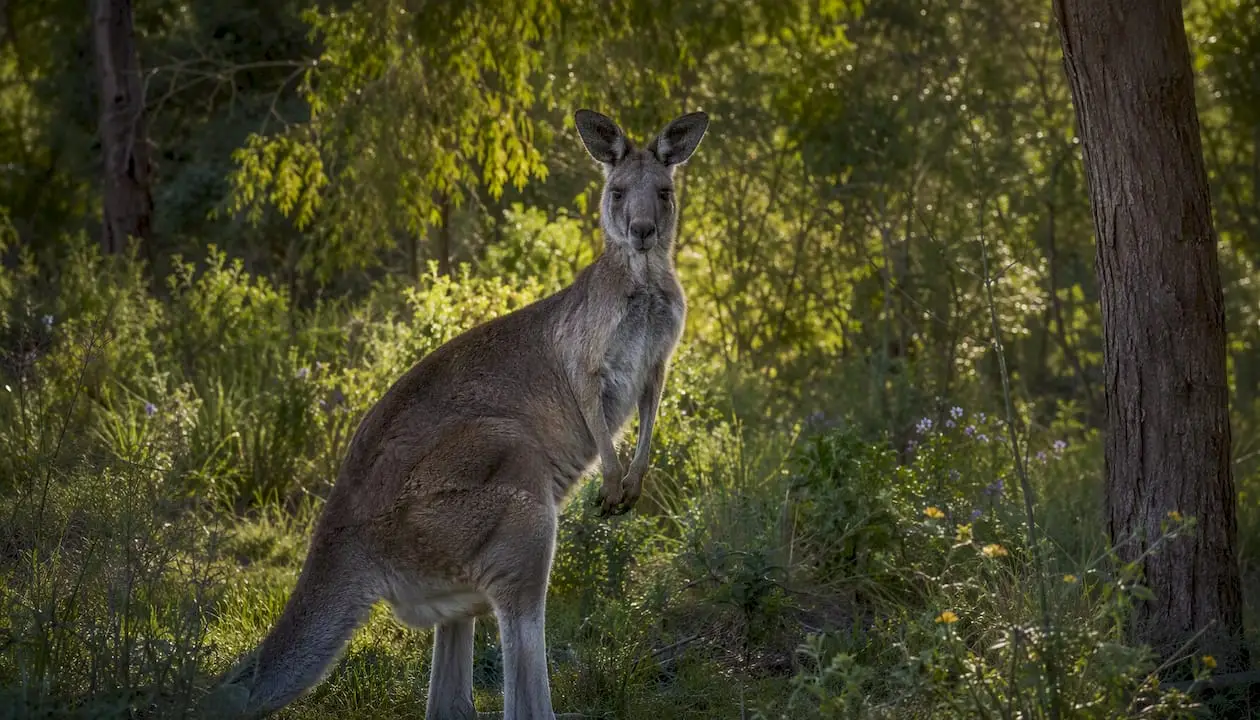
The easiest places to see wild kangaroos in Australia are Lucky Bay in Western Australia (kangaroos lounge on white sand at dawn), the Anglesea Golf Club just 90 minutes from Melbourne, and Pebbly Beach in Murramarang National Park on the NSW South Coast. All three are genuinely wild settings where sightings are often possible at the right time of day.
Quick shortlist — reliable spots to start with:
- Lucky Bay, WA — kangaroos rest on the beach itself; arrive at sunrise for the best light
- Anglesea Golf Club, VIC — eastern greys graze the fairways year-round, 90 minutes from Melbourne
- Pebbly Beach / Murramarang NP, NSW — roos come right down to the campground at dusk
- Cape Hillsborough, QLD — kangaroos and wallabies descend to the beach at low tide each morning
- Tidbinbilla Nature Reserve, ACT — 40 minutes from Canberra city centre, reliable open grassland mobs
- North Gorge Walk, North Stradbroke Island, QLD — coastal headland walk with wallabies and roos in view
Pro Tip: Arrive at dawn or dusk. Kangaroos are most active in low light and will often be in open grassland or on the beach edge. Never feed them — Queensland Government guidance warns that feeding creates dependence, health problems, and aggressive behaviour.
Key takeaways
The most reliable way to see wild kangaroos in Australia is to arrive at dawn or dusk at a known grassland or coastal site, keep your distance, and never feed the animals.
| Point | Details |
|---|---|
| Best time of day | Dawn and dusk are peak activity periods; midday sightings are possible but far less reliable. |
| Top beach spots | Lucky Bay (WA) and Cape Hillsborough (QLD) offer the most consistent beach kangaroo sightings in Australia. |
| Near major cities | Anglesea Golf Club (90 min from Melbourne) and Tidbinbilla (40 min from Canberra) are the easiest near-city options. |
| Never feed kangaroos | Feeding creates dependence, health problems, and aggressive behaviour, per Queensland Government guidance. |
| Guided tours | Aussie Loop curates small-group, responsible wildlife tours across Australia, bookable at visit-cairns.local/tours. |
Table of Contents
- Best places to see kangaroos by state and territory
- Kangaroos on beaches: the coastal spots worth planning around
- Quick kangaroo-spotting options near Australia’s major cities
- How to maximise sightings and stay safe around kangaroos
- Why a guided tour often gives you a better sighting
- The part of kangaroo watching most visitors get wrong
- Curated wildlife tours worth booking before you go
- Sources
- FAQ
Best places to see kangaroos by state and territory
Victoria
Victorian government guidance confirms eastern grey kangaroos are common near people across the state and most active at dawn.
- Anglesea Golf Club — eastern greys graze the fairways daily; 90 min from Melbourne via the Great Ocean Road; free to view from the public road
- The You Yangs Regional Park — open granite country with reliable mobs; 50 min south-west of Melbourne; short walks from the main car park
- Gresswell Forest / Plenty Gorge / Lysterfield Park — three Melbourne fringe reserves with resident eastern grey populations; all within 30–45 min of the CBD
- Wilsons Promontory National Park — kangaroos and wallabies around Tidal River campground at dusk; 3 hrs from Melbourne; park entry fee applies
New South Wales
- Kangaroo Valley — rolling farmland and bush reserves 2 hrs south of Sydney; roos visible in paddocks and along the Kangaroo River flats at dawn
- Crowdy Bay National Park — coastal heath and wetlands on the Mid North Coast; kangaroos graze the campground clearings; 3.5 hrs from Sydney
- Murrumbidgee Valley Nature Reserve (NSW Riverina) — NSW National Parks notes eastern grey kangaroos live here and recommends early morning or late afternoon for wildlife spotting; the Koala Walking Track is the key route
- Murramarang National Park / Pebbly Beach — kangaroos on the beach and in the campground; 3 hrs south of Sydney
Queensland
- Cape Hillsborough National Park — kangaroos and agile wallabies come to the beach at low tide; 1 hr north of Mackay; free entry, short beach walk
- North Gorge Walk, North Stradbroke Island (Minjerribah) — 2.5 km coastal loop from Cylinder Beach; wallabies and kangaroos on the headland; 1 hr from Brisbane by ferry
- Carnarvon Gorge, QLD — red kangaroos and wallaroos in the gorge; 6 hrs from Brisbane; camping available
Western Australia
- Lucky Bay, Cape Le Grand National Park — the most photographed beach kangaroo spot in Australia; a drive from Esperance; book park access via the WA parks portal before you go
- Yanchep National Park — 50 min north of Perth; western grey kangaroos in open bushland; short loop walks from the visitor centre
- Fitzgerald River National Park — southern WA coast; kangaroos and wallabies in heath country; 3 hrs from Perth
South Australia
- Flinders Ranges (Wilpena Pound) — red kangaroos and euros in open rocky country; 5 hrs from Adelaide; camping and lodge accommodation
- Cleland Wildlife Park, Adelaide Hills — 30 min from Adelaide CBD; walk-through kangaroo area with free-roaming eastern greys; entry fee applies
- Innes National Park, Yorke Peninsula — western grey kangaroos on coastal heath; 3 hrs from Adelaide
Tasmania
- Bonorong Wildlife Sanctuary, Brighton — 25 min from Hobart; free-roaming kangaroos in a conservation setting; the Russell Falls and Bonorong day tour combines this with a waterfall walk
- Freycinet National Park — eastern grey kangaroos around Coles Bay township and the campground at dusk
- Maria Island National Park — car-free island; kangaroos and wombats graze the old settlement area freely
Northern Territory
The NT is home to ten macropod species, including antilopine kangaroos and common wallaroos. Interference without a permit is prohibited.
- Litchfield National Park — agile wallabies and antilopine kangaroos in open woodland; 1.5 hrs from Darwin
- Nitmiluk (Katherine Gorge) National Park — wallaroos on the gorge escarpment; 3 hrs from Darwin
- Uluru-Kata Tjuta National Park — red kangaroos in spinifex country at dawn; cultural protocols apply; stay on marked paths
ACT
- Tidbinbilla Nature Reserve — 40 min from Canberra; open grassland mobs of eastern greys; excellent at dawn
- Australian National Botanic Gardens (ANBG) — kangaroos sometimes graze the ANBG grounds at dawn; free entry; central Canberra location
- Namadgi National Park — large eastern grey populations across subalpine grasslands; 30 min from Canberra
Pro Tip: The ACT government identifies specific vehicle-collision hot spots around Canberra. Slow down significantly on any road through or near these reserves at dusk and dawn.
Kangaroos on beaches: the coastal spots worth planning around
Few wildlife moments match seeing a kangaroo silhouetted against a pale dawn sky on an empty beach. These coastal locations deliver that reliably.
1. Cape Hillsborough, Queensland
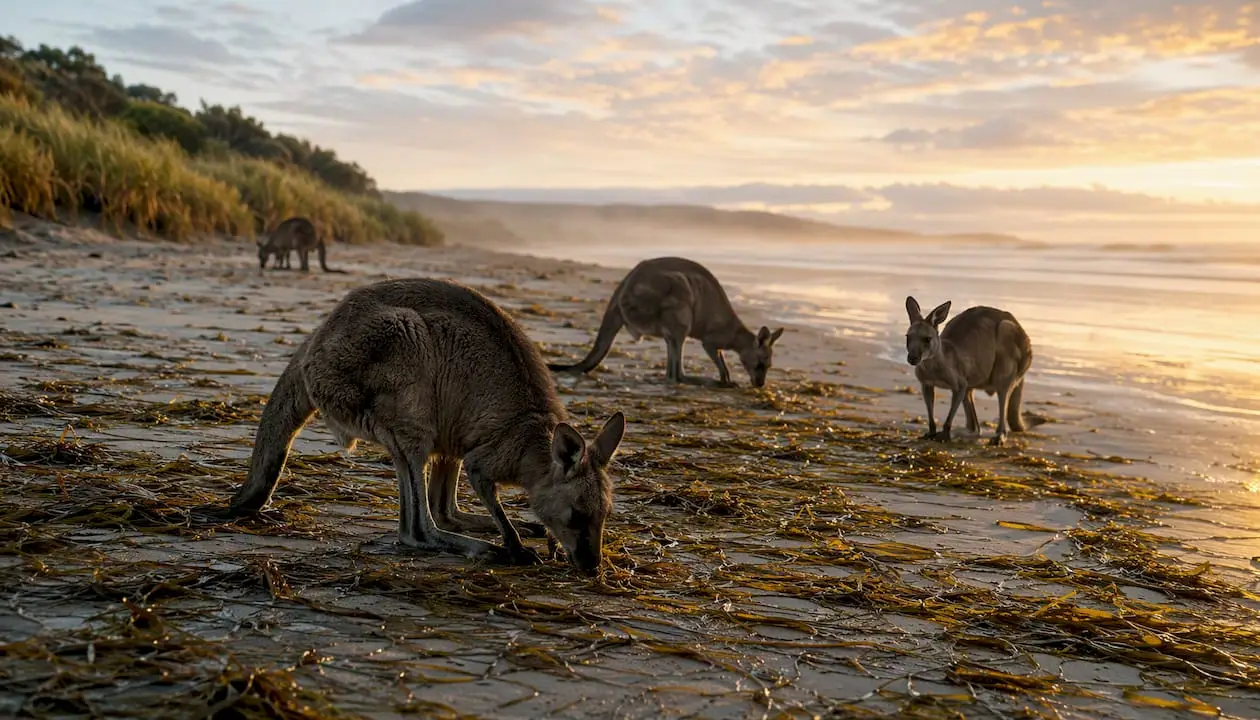
Agile wallabies and eastern grey kangaroos descend to the beach at low tide each morning to graze on washed-up seagrass. Arrive before sunrise and walk quietly from the car park to the beach edge. The combination of golden light, calm water, and wildlife is extraordinary. Cape Hillsborough is 1 hour north of Mackay; no entry fee.
2. Lucky Bay, Cape Le Grand National Park, Western Australia
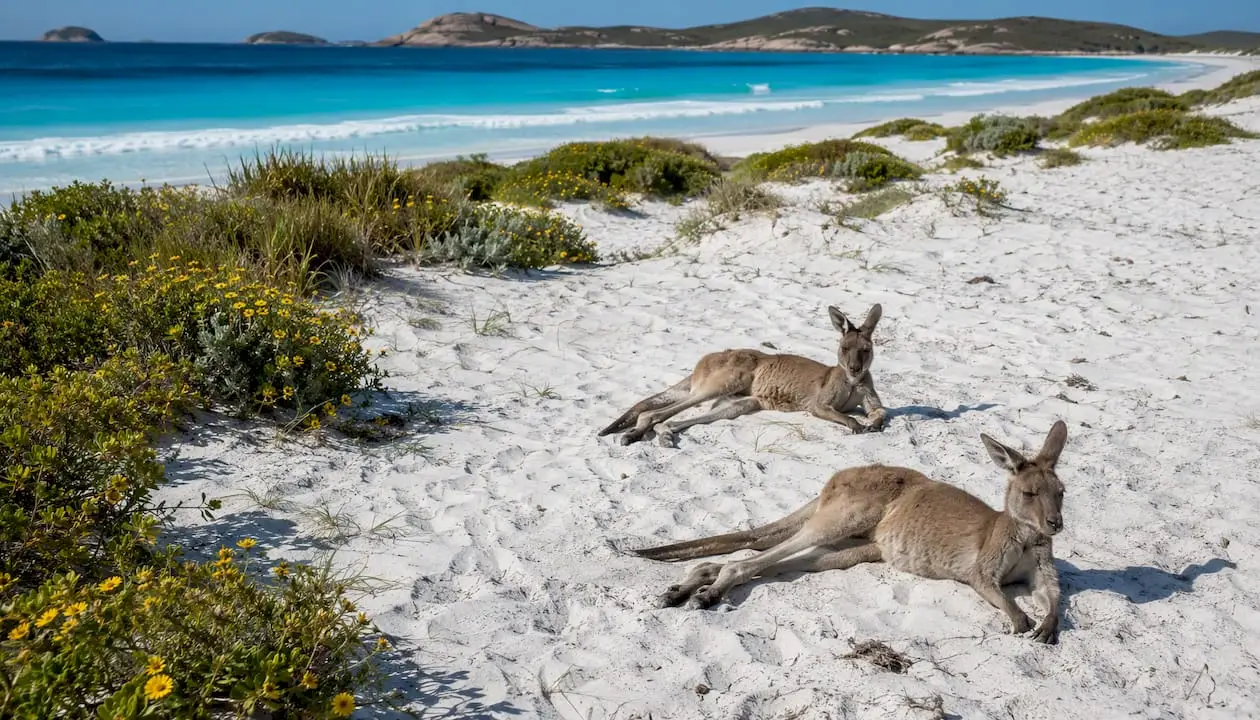
Lucky Bay has white quartz sand so bright it almost hurts to look at, and western grey kangaroos rest on it as though they own the place. Dawn is the best time, but roos are often present through the morning. Book your park stay in advance — Lucky Bay campsite fills quickly, especially in school holidays. Esperance is the nearest town, 50 km away.
3. Crowdy Bay National Park, New South Wales
Kangaroos graze the grassy clearings behind the dunes at Diamond Head campground. The beach itself is wild and largely undeveloped. Arrive at dusk or early morning and walk the short track from the campground to the headland. About 3.5 hours north of Sydney.
4. Pebbly Beach, Murramarang National Park, New South Wales
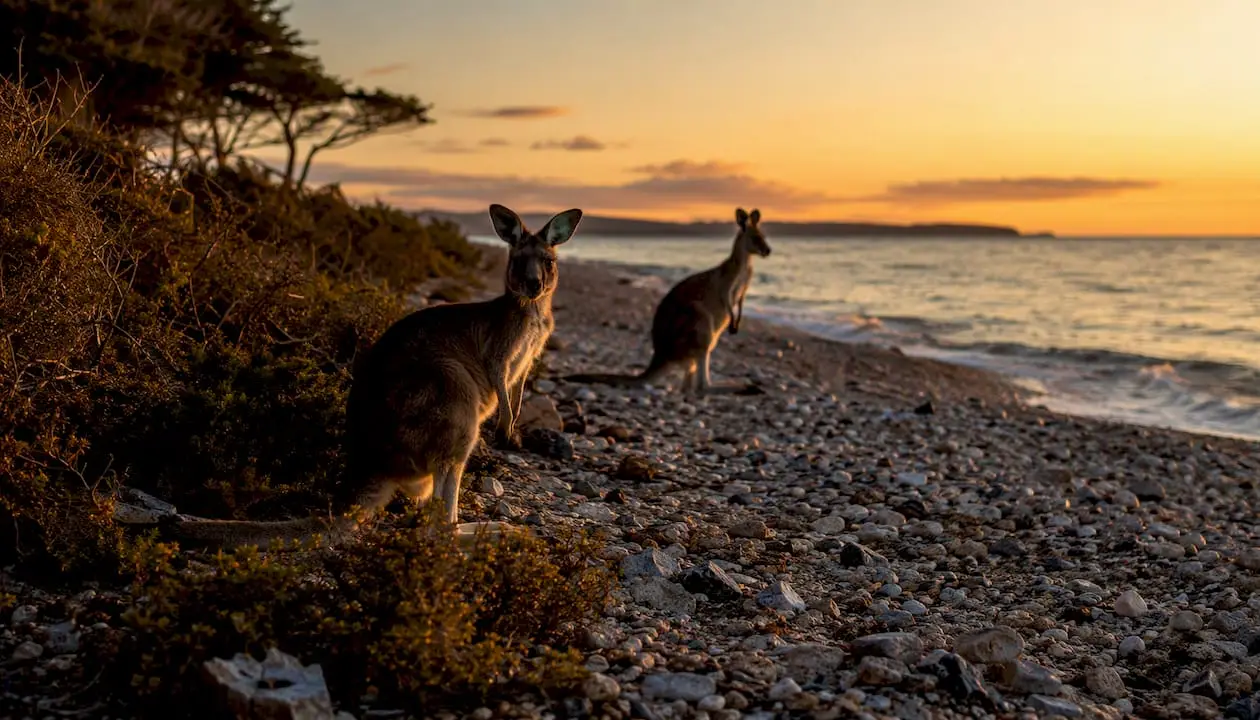
Kangaroos come down to the beach and campground at Pebbly Beach with impressive regularity. The beach faces east, which makes morning light ideal for photography. The roos here are habituated to people but still genuinely wild — keep your distance and never feed them.
5. Friendly Beaches, Freycinet National Park, Tasmania
Eastern grey kangaroos graze the heath behind the dunes in the early morning. The beach is remote and strikingly beautiful. Access is via a short walk from the car park off the Coles Bay Road.
Pro Tip: For beach photography at dawn, set your camera to a slightly higher ISO and use the horizon as a natural reflector. Silhouette shots work best in the 15 minutes just before the sun clears the water. Keep at least 5 metres between you and any animal — closer than that and you risk a stress response that ends the sighting.
Quick kangaroo-spotting options near Australia’s major cities
You do not need to drive for hours to see wild kangaroos. Every major city has reliable spots within an hour or two.
Melbourne
- Gresswell Forest / Plenty Gorge / Lysterfield Park — three separate reserves, all within 30–45 min of the CBD; eastern greys in open woodland
- The You Yangs — 50 min south-west; granite outcrops and open grassland; short walks from the main car park
- Anglesea Golf Club — 90 min via the Great Ocean Road; the most reliable mob in Victoria; free to view from the roadside
Sydney
- Royal National Park — 1 hr south; kangaroos in the heathland around Audley and Bundeena
- Ku-ring-gai Chase National Park — 1 hr north; wallabies and grey kangaroos on the walking tracks
- Kangaroo Valley — 2 hrs south-west; open farmland with reliable dawn sightings
Canberra
- Tidbinbilla Nature Reserve — 40 min; the most reliable spot near Canberra for large mobs
- Namadgi National Park — 30 min; subalpine grasslands with high kangaroo density
- ANBG — central Canberra; occasional dawn sightings on the garden lawns
The ACT government specifically warns about vehicle collisions near Canberra reserves at dusk. Drive slowly and watch the verges.
Brisbane
- North Stradbroke Island (Minjerribah) — 1 hr by ferry from Cleveland; North Gorge Walk has wallabies and kangaroos on the coastal headland
- D’Aguilar National Park — 30 min from Brisbane CBD; wallabies and grey kangaroos in open forest
Adelaide
- Cleland Wildlife Park — 30 min from the CBD; free-roaming eastern greys in a conservation setting
- Flinders Ranges — 5 hrs; red kangaroos in spectacular outback country
Perth
- Yanchep National Park — 50 min north; western grey kangaroos in open bushland; short loop walks from the visitor centre
- John Forrest National Park — 35 min east; kangaroos and wallabies in jarrah forest
How to maximise sightings and stay safe around kangaroos
Timing is the single biggest factor. Victorian government guidance confirms kangaroos are most active at dawn and dusk. Midday sightings happen, but the animals are typically resting in shade and much harder to spot.
Approach technique
A 2010 study on kangaroo disturbance found that kangaroos showed lower flight responses to vehicles than to people approaching on foot. If you are driving through a reserve, slow to a crawl and stop at a distance. On foot, use a stop-and-go technique: move a few steps, pause, wait, then move again. Avoid talking loudly.
Do and don’t checklist
Do:
- Arrive at dawn or dusk
- Keep at least 5–10 metres from any animal
- Keep dogs on a lead at all times — NSW National Parks notes that dogs greatly increase kangaroo stress and can drive animals toward roads
- Move slowly and quietly
- Use binoculars to observe from a distance
Don’t:
- Feed kangaroos — Queensland Government guidance is clear that feeding creates dependence, health problems, and aggressive behaviour
- Chase or corner an animal
- Make sudden movements or loud noises
- Approach a joey or a mother with a pouch young
If a kangaroo approaches or becomes aggressive
Remain calm. Avoid direct eye contact. Turn side-on to the animal and back away slowly. If necessary, crouch to protect your face and neck. Large male kangaroos can cause serious injury — give them space.
Road safety
Tourism Australia recommends driving carefully at dawn and dusk and contacting local wildlife-rescue organisations if you find an injured animal. In the ACT, collision hot spots are documented and signposted — take them seriously.
Pro Tip: Look for fresh scat and grazed grass patches to find where a mob has been feeding. Kangaroos return to the same grazing areas repeatedly, so a spot with signs of recent activity is worth waiting near at the next dawn.
Why a guided tour often gives you a better sighting
Local guides know exactly where mobs are on any given morning. That local knowledge alone can be the difference between a confirmed sighting and a long, fruitless walk.
Benefits of a guided wildlife experience:
- Local knowledge — guides track mob movements daily and know the best access points
- Safety — a good guide manages distances, handles close encounters, and carries emergency contacts
- Minimised disturbance — small groups with trained leaders cause far less stress to wildlife than large independent groups
- Interpretive context — understanding kangaroo behaviour, body language, and ecology makes the experience richer
- Better odds — guides use timing, terrain, and approach techniques that most independent visitors miss
What to look for when choosing a tour:
- Small group sizes (typically under 12 people)
- Demonstrated wildlife-ethics policy and park permits
- Local guides with genuine field experience
- Clear safety briefing before the tour begins
- Transparent cancellation and rescheduling policy
Aussie Loop curates wildlife and nature tours across Australia selected by local experts, including options in Queensland, Tasmania, and the Northern Territory. Browse the full tours listing to find a responsible, small-group experience near your destination.
The part of kangaroo watching most visitors get wrong
There is a tendency to treat kangaroo spotting as a passive activity — you show up, you see a kangaroo, you take a photo, you leave. The reality is that how you behave in those few minutes shapes the animal’s experience of people for months afterward.
Kangaroos that are fed regularly by visitors become bold, sometimes aggressive, and increasingly dependent on human food that damages their gut flora. Kangaroos that are repeatedly approached too closely become hypervigilant, burning energy on flight responses instead of grazing. Over time, that stress accumulates. Responsible wildlife tourism guidance goes well beyond “don’t feed” — it covers low-impact viewing techniques, quiet observation, and reading the animal’s body language to know when to stop and when to back away.
The places on this list are remarkable precisely because they are genuinely wild. Keeping them that way is a collective responsibility. Arriving at dawn, staying quiet, keeping your distance, and leaving no trace are not inconveniences — they are the price of admission to something most people in the world will never see.
Curated wildlife tours worth booking before you go
Knowing where to look is one thing. Getting there with a local guide who has already scouted the mob, knows the access track, and can read kangaroo body language in real time is a different experience entirely.
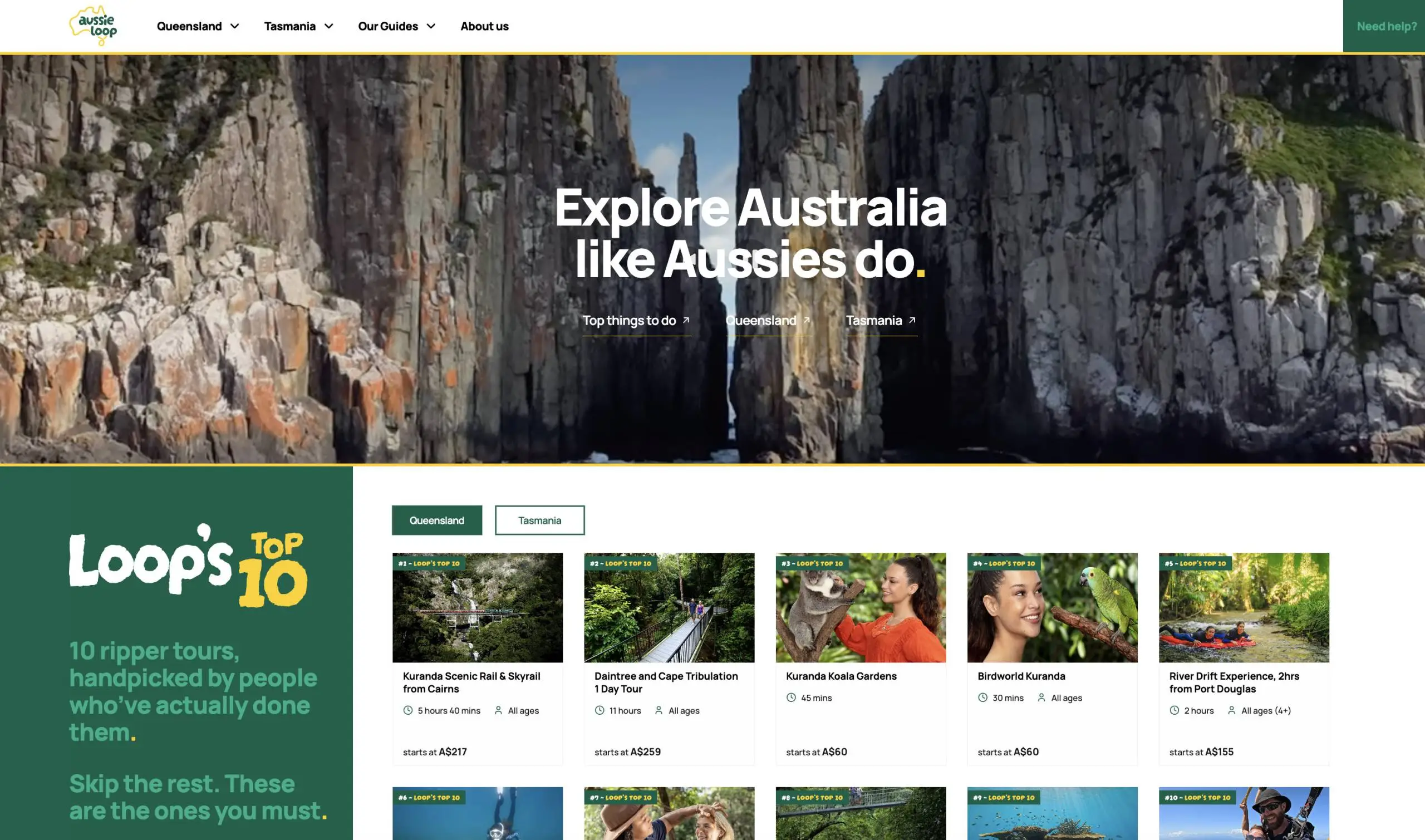
Aussie Loop handpicks wildlife and nature tours across Australia, chosen by locals who know the terrain. Every listed tour prioritises small groups, responsible wildlife practice, and genuine local expertise. Options range from nocturnal spotting in the Daintree to wildlife sanctuary experiences in Tasmania, including the Hobart and Bonorong Wildlife Sanctuary tour for close encounters with native fauna near Hobart.
- Small-group tours with local, experienced guides
- Tours operating across Queensland, Tasmania, and beyond
- Wildlife-ethics policies built into every listed experience
- Easy online booking with clear inclusions
Browse the Australian wildlife tours on Aussie Loop and book a responsible experience that gives you the best possible chance of a genuine sighting.
Sources
Always check current park alerts and access conditions before you travel — closures, fire restrictions, and seasonal access changes can affect any of the locations listed above.
- Kangaroos (Queensland Government)
- Safety tips for wildlife encounters | NSW National Parks
- Living with wildlife – kangaroos (Wildlife Victoria / VIC government PDF)
- Kangaroo and wallaby | NT.GO
- Living with kangaroos (ACT government)
- Koala walking track (Murrumbidgee Valley Nature Reserve) | NSW National Parks
- Tips for responsible wildlife tourism in Australia – Tourism Australia
- Minimizing disturbance to wildlife by tourists approaching on foot or in a car: A study of kangaroos (2010)
FAQ
Where is the best place to see kangaroos in Australia?
Lucky Bay in Cape Le Grand National Park (WA) and Cape Hillsborough in Queensland are widely regarded as the most spectacular spots, with kangaroos appearing on the beach itself at dawn. For ease of access near a major city, Anglesea Golf Club (90 minutes from Melbourne) and Tidbinbilla Nature Reserve (40 minutes from Canberra) are consistently reliable.
Where can I see kangaroos in Queensland?
Cape Hillsborough National Park (1 hour north of Mackay) is the standout Queensland location, with kangaroos and wallabies on the beach at low tide each morning. North Stradbroke Island’s North Gorge Walk, just over an hour from Brisbane by ferry, also offers reliable coastal sightings.
Where can I see kangaroos outside Melbourne?
The You Yangs Regional Park (50 minutes south-west) and Anglesea Golf Club (90 minutes via the Great Ocean Road) are the most reliable options. Wilsons Promontory (3 hours south) offers kangaroos and wallabies around the Tidal River campground at dusk.
What part of Australia has the most kangaroos?
Kangaroos are most densely concentrated across inland eastern Australia, particularly in NSW, Queensland, and South Australia, where open grasslands and pastoral country provide ideal grazing habitat. Red kangaroos dominate the arid interior, while eastern grey kangaroos are the species most commonly seen near cities and coastal areas along the east coast.
Is it safe to approach kangaroos in the wild?
Keep at least 5–10 metres from any wild kangaroo and never approach a mother with a joey. NSW National Parks safety guidance recommends backing away slowly if an animal approaches you, avoiding eye contact, and turning side-on rather than facing the animal directly.